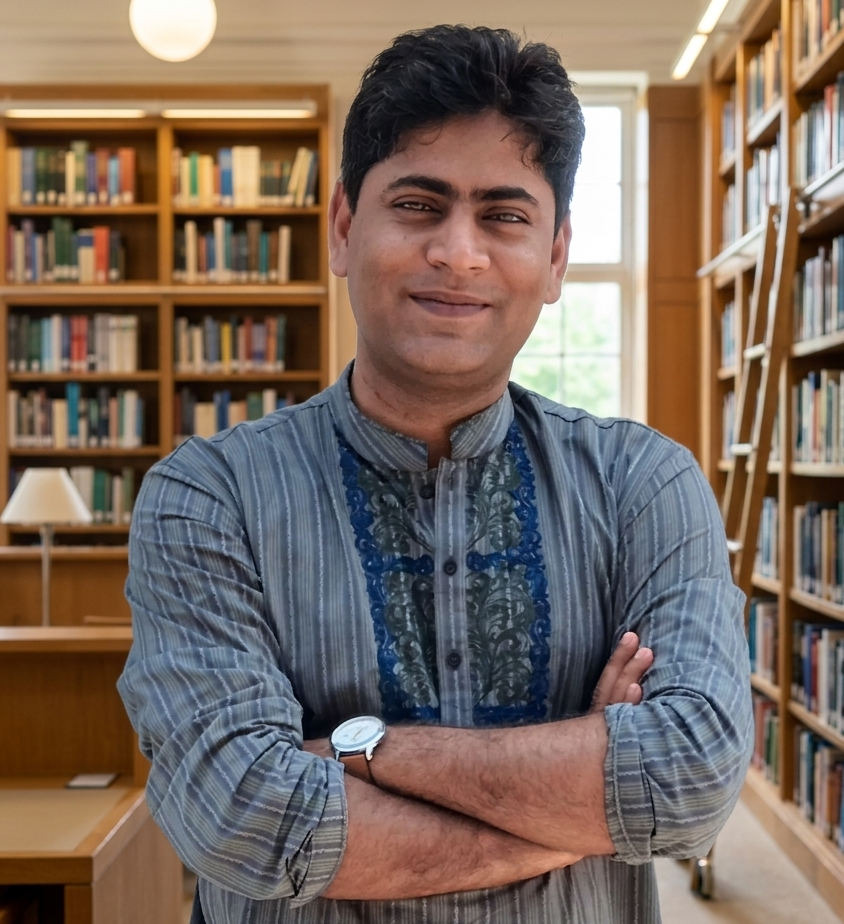
EXTERNAL PROFILES


Associate Professor
Dr. Khandakar Ashraful Islam
N/A
English
BIOGRAPHY
Dr. Khandakar Ashraful Islam, (ORCID: 0000-0002-0176-4518), is an Associate Professor in the Department of English, Noakhali Science and Technology University. Under ICCR (Indian Council for Cultural Relations) Fellowship he obtained his PhD degree from the Department of English, Osmania University, Hyderabad, India in 2021. His research expertise is concentrated on postcolonial literature, subaltern literature and Indian literature in English. His research articles have appeared in reputed peer reviewed journals like Crossroads: A Journal of University of Bialystok (Scopus Indexed), Spectrum: A Journal of the Department of English University of Dhaka, Crossings: ULAB Journal of English Studies, English Studies in India: A Journal of University of Kashmir. Moreover, he has participated in numerous national and international conferences, symposiums and trainings. He is currently engaged in a research project on the plights and struggles of the scavenger community in India and Bangladesh.
RESEARCH INTERESTS
2016 - 2021
PhD
English
Osmania University, Hyderabad, India
2008 - 2009
Master of Atrs
English
University of Chittagong, Bangladesh
2005 - 2008
BA (Hons.)
English
University of Chittagong, Bangladesh
Last updated on 2026-05-05 10:33:01
No Jobs Found...
No Project Found...
No Training information...
No workshop information...
AWARDS AND ACHIEVEMENTS
1
Commonwealth Fellowship Scheme
Indian Council for Cultural Relations, India
Description: PhD in English Literature2025
Journal
Conscientization and Subaltern Resistance: A Freirean Reading of Pillai’s Scavenger’s Son and Jaladas’s Ramgolam
Authors: Khandakar Ashraful Islam
Journal: Forum for World Literature Studies
2025
Journal
Sexual Subject and Textual Braid: Autobiographical Politics of Emancipation in Audre Lorde’s Zami
Authors: Popy, Shirin Akter and Khandakar Ashraful Islam
Journal: ES Review: Spanish Journal of English Studies
DOI: https://doi.org/10.24197/8j6vqs85
2023
Journal
Elusive Idea of Nationhood and Bifurcated Identity in Amitav Ghosh’s The Glass Palace
Authors: Islam, Khandakar Ashraful
Journal: Overtones Ege Journal of English Studies
2021
Journal
Biopolitical Nomos and “bare life” in Arundhati Roy’s novels
Authors: Islam, Khandakar Ashraful
Journal: Crossroads. A Journal of English Studies
DOI: https://doi.org/10.15290/10.15290/CR.2021.34.3.02
2020
Journal
"Things can change in a day": Rereading Arundhati Roy’s Novels in the Dichotomy of “Change"
Authors: Islam, Khandakar Ashraful and Shirin Akter Popy
Journal: Crossings: A Journal of English Studies
DOI: https://doi.org/10.59817/cjes.v11i.47
2016
Journal
(Re)tracing Resistance from a Culture of Silence: An Alternate Reading of the ‘Jele’ (fishing) Community
Authors: Islam, Khandakar Ashraful
Journal: Crossings: A Journal of English Studies
DOI: https://doi.org/10.59817/cjes.v7i.163
2016
Journal
Nature: A Warrior or a Victim of War? Reading Midnight’s Children in the Light of the Liberation War of Bangladesh (1971)
Authors: Islam, Khandakar Ashraful
Journal: Spectrum: Journal of the Department of English, University of Dhaka
2015
Journal
American Dream: A Myth of Success or Mirage?: An Investigation into Lahiri’s The Namesake and Unaccustomed Earth
Authors: Islam, Khandakar Ashraful
Journal: English Studies in India: A Referred Journal of English Literature and Language
No Data Found
No Data Found
No Data Found
No Courses Found....
No Course Materials Found....
Masters - 2021-22
Md. Abdur Rahman
Assistant Teacher
Thesis Title: Postcolonial Melancholia and Diasporic Crisis in Abdulrazak Gurnah’s Admiring Silence
Overview: This thesis examines Abdulrazak Gurnah’s Admiring Silence through the lens of postcolonial melancholia, camp mentality, and imagined communities as theorized by Paul Gilroy, Benedict Anderson and Charles Taylor. This study focusing on the unnamed Zanzibari protagonist’s migration to Britain, analyzes how unresolved imperial nostalgia, entrenched racial prejudice, and exclusionary national narratives hinder the formation of stable diasporic identity. Through close reading, this research highlights the structural and psychological barriers faced by migrants from former British colonies, showing how societal hostility and misrecognition disrupt dialogical identity formation. Findings reveal that the protagonist’s coping strategies, including narrative mimicry, self-silencing, and identity fabrication, fail to secure recognition or acceptance within British society. This study argues on the point that as long as Britain’s national imaginary remains steeped in postcolonial melancholia and xenophobia, meaningful dialogue and the integration of migrants into its social fabric remain unattainable, leaving diasporic identities fragmented and unfulfilled.
Masters - 2020-21
Rupam Bhowmik Shuva
Lecturer of English at Atish Dipankar University of Science and Technology, Dhaka
Thesis Title: Memory, Identity, and Socio-political Reality: A Psychosocial Study of Shahidul Zahir’s Life and Political Reality and Abu Ibrahim’s Death
Overview: Memory and identity are often intricately woven into the fabric of social, political, and cultural landscapes. Individual memory depends on the socio-political structures for its formation and representation. The social and political dynamics provide the lens through which members of a society navigate their psychosocial experiences which in fact, construct their collective identity. The social and political structures have a profound impact on the personal dimension of memory and the formation of individual and collective identity. This thesis, taking Maurice Halbwachs’ and Jan Assmann’s theories on collective memory and Jeffrey C. Alexander’s and Ron Eyerman’s ideas on cultural trauma as the theoretical framework, investigates the interplay between memory, identity, and socio-political influences in the context of Shahidul Zahir’s novellas, Life and Political Reality (1987) and Abu Ibrahim’s Death (2009). Each of the selected novellas portrays the relationship between individual and collective memory and exhibits how social and political frameworks influence the construction, preservation, andinterpretation of those memories. The major characters within each novella strive to represent their past in the face of opposition from the social and political structures. Tracing the essential events of these novellas through the theoretical lenses of memory and trauma studies, this thesis aims to provide insights into the role of memory in reconstructing individual and collective identity based on the present social and political reality. Additionally, it aims to argue on the struggle of representing the past and the challenge of establishing identity in the face of conflicting social and political values. Keywords: Shahidul Zahir, Memory, Trauma, Identity, Social framework, Socio-political Reality, Representation.
Masters - 2019-20
Jannatul Mawa
Lecturer of English at Atish Dipankar University of Science and Technology, Dhaka
Thesis Title: Trauma, Memory, and Nostalgia in Haruki Murakami’s Norwegian Wood and Stephen Chbosky’s The Perks of Being a Wallflower
Overview: Enter Project/Thesis Overview Traumatic experiences directly influences the physical and mental health of the victims. These negative experiences sometimes lead to Post-Traumatic Stress Disorder (PTSD) which could result in physical injury through self-harm, anxiety and depression, low self-esteem, social difficulties, and suicide tendency. Study reveals that these sorts of emoticons are universal among all the trauma survivors. Trauma indiscriminate to gender culminates in negative traits such as chronic depression, anger management issues, continual existential crises, dissociation, unhealthy coping mechanisms e.g. alcohol/drug consumption, self-harming, self-blaming tendencies etc. This paper aims to review memory and trauma impact on male victims and theoretically analyzes how traumas reflected from a male point of view are equally devastating as a female victim.
- Institutional Email: ashraf.2205@nstu.edu.bd
- Personal Email: ashraf.2205@gmail.com
- Mobile number: +8801322241368
- Emergency Contact: +8801322241367
- PABX:N/A
- Website:N/A
SOCIAL PROFILES
Department
English
Noakhali Science and Technology University